Starfieldmight be the most ambitious game that Bethesda has ever developed. It’s undoubtedly the largest, giving players more than 100 star systems with over 1,000 planets to explore. While the game will not offer a seamless transition from space to surface,Starfieldplayers can still land anywhere and forge a path through the unexplored alien wilderness. While games likeElite DangerousandNo Man’s Skymay haveStarfieldbeat in the sheer scale of their explorable galaxies, 1,000 planets is still an impressive number.
What all three games have in common is that they rely on procedural generation to create their gigantic galaxies. InStarfield’s case, Bethesda uses procedural generation to create planetary landscapes and environments while still hand-crafting major locations like cities. However, whilethe upcomingStarfieldDirect showcasemight ease some concerns when it goes live on June 11, the game’s procedural generation has as many risks as it has rewards.
RELATED:Starfield ESRB Description Reveals a Little About the Game’s Romantic Encounters
Starfield’s Procedural Generation
It’s worth clarifyingwhatStarfield’s procedural generation looks likeand how Bethesda intends to use it. “Random generation” and “procedural generation” are often used interchangeably, but that’s only half true. Procedural generation is a method of using algorithms, which are a type of mathematical equation, to create computer data. Usually, it combines these mathematical equations with human-made assets to create things ranging from textures and 3D models to entire virtual environments.
Technically speaking, there’s no such thing as random generation. ‘Random’ and ‘procedurally generated’ games both work off a number called a seed, which the algorithm uses to generate an environment. The same seed always produces the same result when put through the same algorithm. However, the term “randomly generated” usually refers to algorithms with few limits on the kind of objects or environment they can create. For example, nothing stops a randomly generated game world from building a house on an inaccessible mountaintop.

Meanwhile, saying “procedural generation” usually denotes cases where developers put stricter limits on what the game can create. Developers might program rivers to only follow the path of least resistance across the terrain or ensure that a dense forest section can’t spawn directly adjacent to an open desert.Starfield’s own approach to procedural generationfalls into this latter category.
The Benefits of Starfield’s Procedural Generation
The main benefit ofStarfield’s procedural generation is that it allows the game to be much larger than would otherwise be possible. Even if each planet was only the size ofSkyrim, making 1,000 of them would be well beyond what developers could do by hand, andStarfield’s planets are many times larger than that. While it’s unlikely that any single player will ever fully explore every planet, the fact that they theoretically could helps capture the sheer scale of the galaxy.
Starfield’s procedural generation also has the potential to create some unique and natural feeling environments. Of course, this will depend heavily on the algorithm Bethesda uses. Still, the technology has come a long way since Bethesda used procedural generation for environments inThe Elder Scrolls: Arenaand its sequelDaggerfall. There are some beautiful and realistic-looking examples of procedurally generated landscapes, and what Bethesda’s shown off so far looks promising.

It’s also great for exploration and emergent gameplay, which Bethesda tries to incorporate into its games as much as possible. These are major selling points for procedurally generated games likeNo Man’s SkyandMinecraft, encouraging players to explore and see what they stumble across. WhileNo Man’s Skysaw a disappointing launch, developers eventually got it to a point where players feel that the game delivered on its promises. Despite its initial problems,No Man’s Skyproves a game likeStarfieldcan work with the right studio behind it. The only question is whether Bethesda is the right studio.
RELATED:Every Starfield Rumor and Leak So Far (May 2023)
The Downsides of Starfield’s Procedural Generation
Of course, there are a few potentially bigproblems withStarfield’s use of procedural generation. The most significant fear is that the planets will be boring and repetitive, which is a valid concern. In fact, this is where the arguments regardingNo Man’s Skywork in reverse. The game might be good now, but it faced criticism at launch for its repetitive planets.
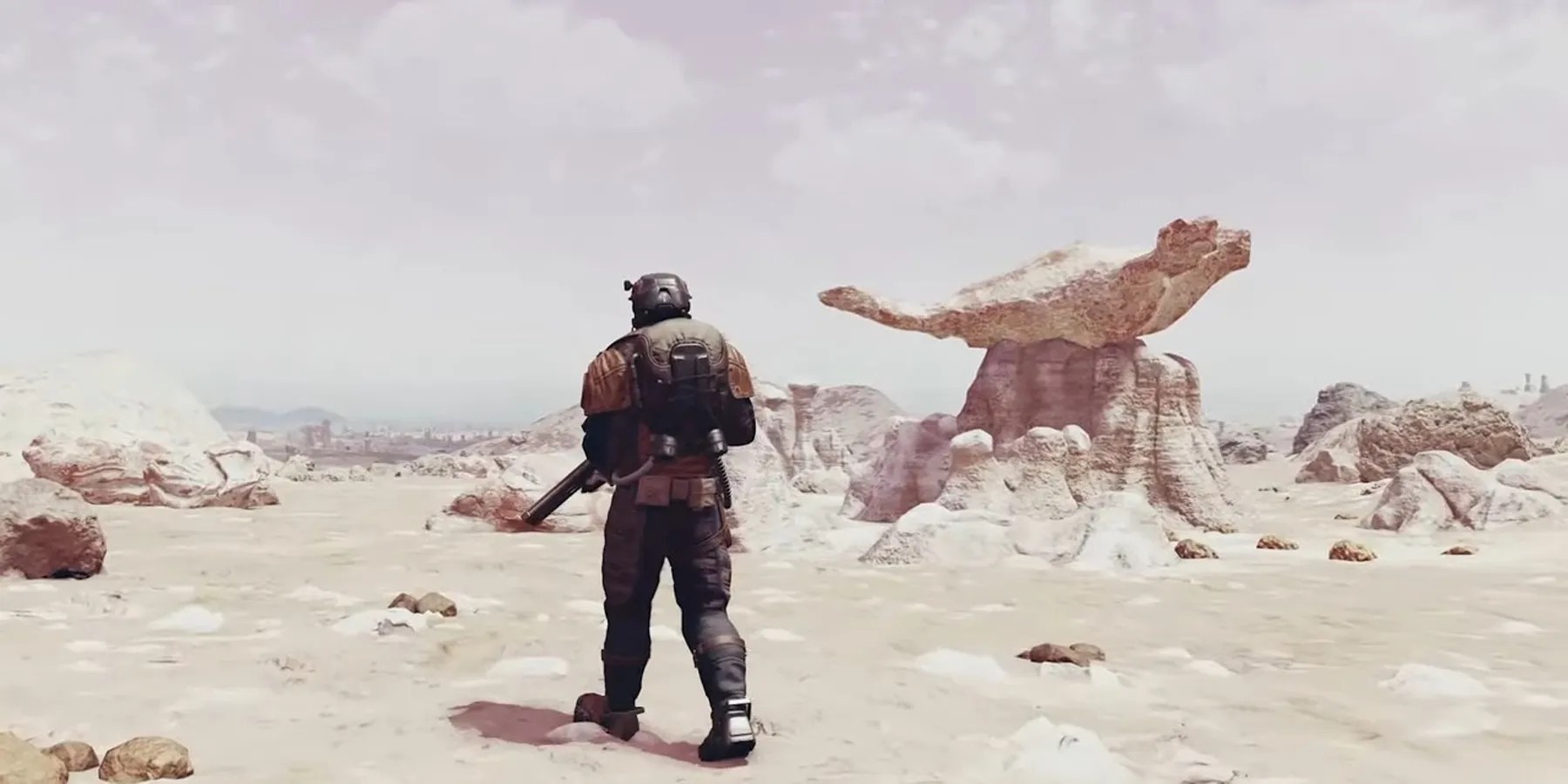
Starfieldmay now face a similar problem. It’s technically possible that a player can land on ten points on a planet’s surface and find ten wholly unique locations. Rather, it seems just as likely that they will find ten variations of the same grey rocks. Bethesda has done little to allay this concern, as it seems like most or all ofStarfield’s planets have a single environment each. This arguably makes sense since one square mile of Martian wasteland doesn’t look that different from any other.
Real planets will still have landmarks and terrain features that stand out as unique, and it’s hard to imagineStarfield’s algorithm creating Olympus Mons. Alternatively, if the algorithm can make landmarks, or if developers design something manually, it begs the question of why players would want to go anywhere else.
Dungeons and encounter design are another problems thatStarfield’s procedural generation faces. A good combat encounter is more than just throwing enemies at the player and telling them to go nuts. Bethesda knows this, and its games have plenty of well-designed combat encounters. SinceStarfield’s random encounters will also be procedurally generated, it may face problems of repetition or illogical design.
The same applies toStarfield’s equivalent of dungeons.Fallout 4was pretty good at making its dungeons feel like places that could exist rather than a haphazard warren of corridors.Starfield’s procedurally generated pirate bases need a logical layout that feels like a cohesive whole rather than a random collection of rooms arbitrarily stuck together. There’s also the risk thatStarfield’s procedural generation might blur together after a while, lacking the uniqueness fans loved inSkyrimandFallout 4’s dungeons. Only time will tell if Bethesda finds a way to make it work.
Starfieldreleases on August 04, 2025 for PC and Xbox Series X/S.
MORE:Starfield’s Aurora Could Take The Elder Scrolls' Skooma to The Next Level
